Christoph Konrad used to be a race engineer. Now he documents car culture around the world.
Christoph Konrad has been documenting car culture through his digital platform Rennframes for the past two years. In this relatively short time frame he’s managed to travel around the world, capturing races, meets, and the people who make it all happen. Below, the Austrian photographer shares a trove of travel stories along with his love for Japanese car culture and analog cars.
.png)
Since starting Renn Frames, how have you seen car culture develop in the social media space?
Since starting this project about two years ago, I noticed people are getting more and more attracted to analog cars. Models like the CLK GTR to mark the pinnacle or chassis like an E46 M3, Ferrari 458 Speziale, Murcielago, 996/997 GT3s, 190 Evo etc. are more desirable than ever. Enthusiasts have of course always had them on their radar, yet there is a general shift in people's appreciation for nostalgia and analog cars are no exception to that. The price tag is not the only value a car holds. Modern luxury vehicles do still attract many for their convenience and comfort, yet the experience of actual driving rather than just arriving has become more valuable. With all the digital benefits and driver assist tools, the urge to feel in control and connected to the machine has increased.
Talk me through one of your most memorable photo shoots?
About 8 months into running Rennframes, I came across photo and video footage of a street-legal Lamborghini Diablo GT2 race car in Japan. Supposedly, it was only one of two chassis ever made for racing in the GT2 series in Europe back in the day. As a race engineer and appreciator of 90s motorsport myself, I was fascinated by the idea of driving one of those on public roads.
I collected all the photos and videos of the car I could find and made a post about it (including credits of course) because I thought it was too cool not to share. The owner then reached out to me, saying that he’s happy I like the car so much and if I ever happen to be in Japan, we can meet so I can have a detailed look in person. One year later I was on my way to the airport in Vienna, Austria (my home country) for a 16-day trip to Japan with my younger brother, when I remembered the invitation. By then, I did lots of photo shoots of various car culture events and special vehicles. I needed to make this meet-up happen.
I reached out to Kinoshita (the owner) again. He did remember me immediately and was down to connect in real life. Fast forward, I met him in his hometown of Ome, around 1 hour west of Tokyo. We were in our Subaru Impreza STI GC8 rental car and when arriving, I already spotted it rolling into the parking lot just in front of us. I think this is still one of the most memorable moments on my entire journey so far. The fact that it’s possible to forge real friendships through social media, felt very wholesome.
We did talk for a while (using the translator since his English was about as good as my Japanese) and took a few shots on a 7/11 parking lot before heading onto the street. After some rolling shots out of the Impreza, Kinoshita stopped in the middle of the road behind me, flashing his hazard lights. Immediately I thought the car might have got hot simply rolling around – a common problem with race cars, they usually depend also on the airstream when racing, especially older models. I hopped out and asked if there was a problem. He said no. I was confused. Then he pointed onto his passenger seat saying I should hop in.
Driving down the streets of Ome, looking at the full racecar interior paired with the sound of the N/A V12 in the back and the whine of the sequential gearbox in between us was probably one of the most surreal experiences of my life. All of this and much more happened because of a DM. That’s what it’s all about in life right? These moments in time we get to experience that make us forget everything else.
What city do you think has the most unique car culture, from your travels?
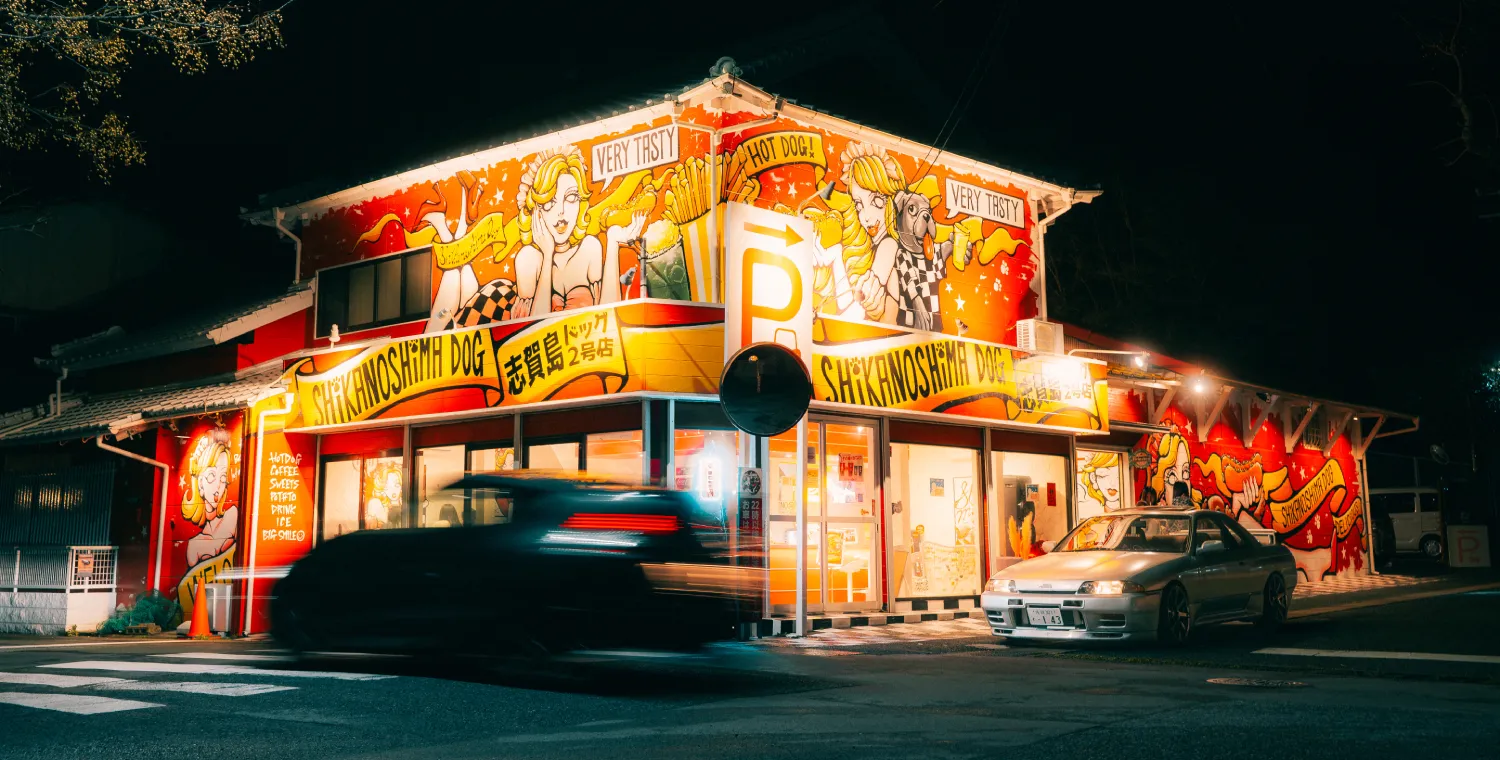
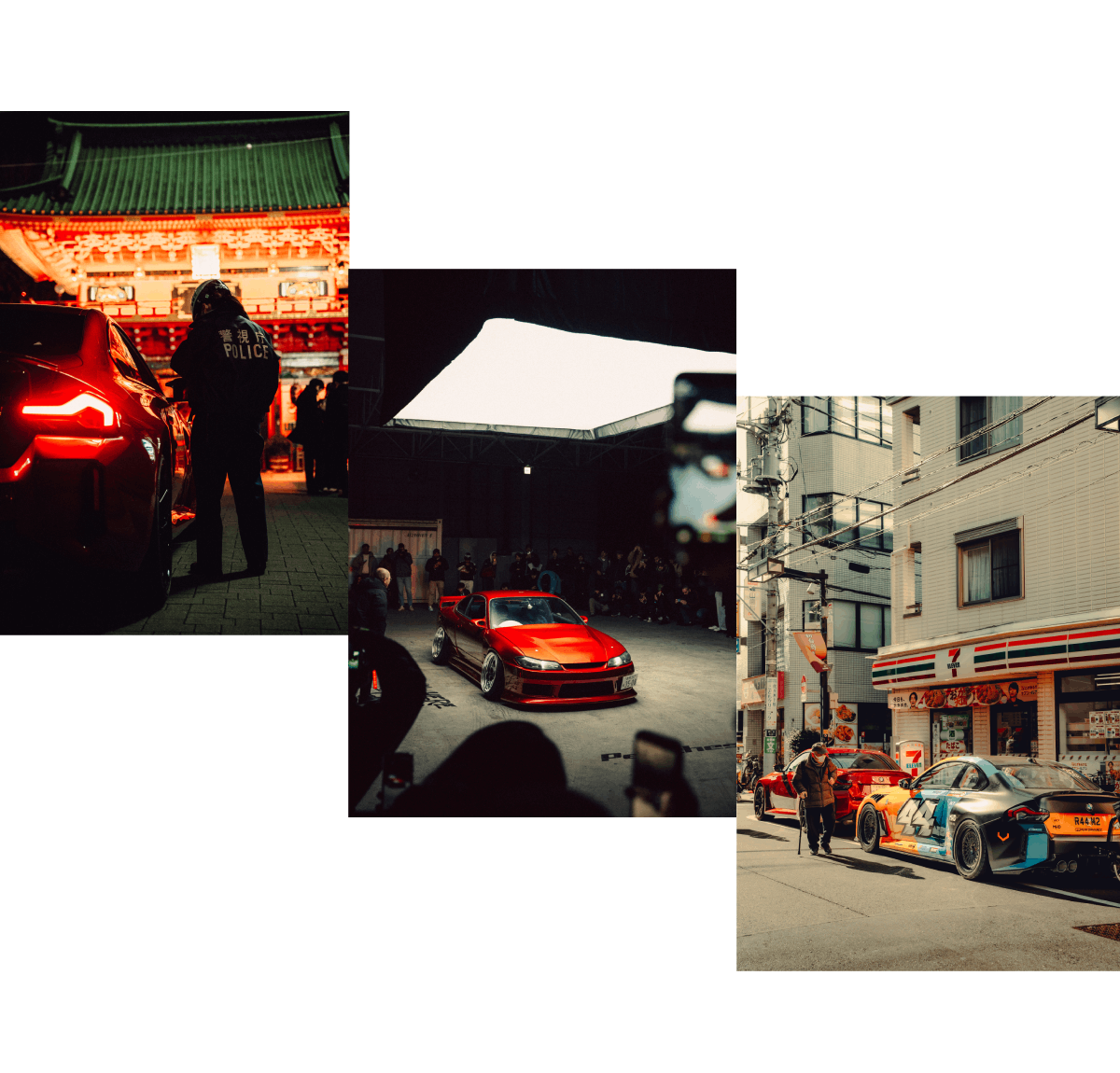
100% Tokyo. If you make your way to Daikoku PA on a Sunday morning, you’ll see pretty much every automotive subculture, both recognizable and the ones you never knew existed. JDM legends alongside screaming straight-piped SVJs, next to drift cars, Group B homologation vehicles, Hummers with scissor doors, street-legal 430 Challenge race cars, stanced German luxury sedans, time attack beasts with huge aero, Bosozoku, GT40s, air-cooled Porsche street racers…I could run this list forever. I have never seen such a variation of cars on a random weekend car meet, ever, anywhere else.
But even just strolling through the city gives you an understanding that the automobile and its customization is deeply rooted in Japanese culture. We spotted a LaFerrari and some 100-year-old, open-top Bentley on the street on a freezing January morning. The European mind cannot comprehend that.
What was your relationship with cars pre-Rennframes?
Been a car guy as long as I (and my parents) can remember. I recall playing Need For Speed at like 4 years old on our old PC. Growing older, I always knew I wanted my profession to be something around cars. I went to a higher technical college for automotive engineering and met some of my best friends to date there. We always made engine noises during class, it was a great time in hindsight.
After graduation I started an engineering job at a huge automotive development partner company, but after some years I found it to be quite unfulfilling. For me, cars were my biggest passion, and working around people who saw this as just another job made me doubt my work environment. Around that time, KTM X-Bow was searching for a Customer Service engineer for their motorsports department in my hometown of Graz. Jackpot. Markus, one of my closest friends on this planet still, sent me the job announcement back then and said that it would be the perfect fit for me. He was right. I got the job. Lots of traveling and overtime, working on weekends, passionate fellow motorsport enthusiasts all around – I absolutely loved it.
I started Rennframes during my time at KTM. By then I already consumed loads of hours of content of entrepreneurs like Ben Francis (Gymshark) or George Heaton (Represent) building brands and publicly documenting it. I was always fascinated about the idea of building a brand from scratch and was dreaming about creating a community around my biggest interest — car culture. I have met the closest people to me through the car community. Although we might pursue different professions, the shared passion for automobiles was always the initial touchpoint.
What kind of insights have you gained from doing Rennframes that wouldn't be possible without it?
Undoubtedly, having some sort of reach on social media compared to a skill gets you good credentials at certain events. You meet inspiring people there and can have a good chat with them far off from the event stress.These connections gave me behind-the-scenes access to iconic places like Kazuki’s Madlane garage and the Nakai-san’s RWB Clubhouse in Japan. Growing up admiring their work, it hits different when you’re stand in their driveway, staring at the cars you once had as a wallpaper on your phone. Driving as a passenger in a 500hp Toyota Chaser on Ultrace’s drift track in Poland will also be a forever memory – thanks to James from Auto Finesse for the ride, you’re a legend.
Thoughts on Chinese car brands?
I think they do one thing very well: EVs and the technology paired to it. Now, I don’t hate electric vehicles and think they have their reason to be here. With that being said, they lack one very important factor in my opinion: soul. Driving them feels quite emotionless for the most part. Yes, there are 1000hp EV supercars on the market, but that’s not the point. You can buy a 330i E46 today and have the time of your life. It’s not always about power. I think Chinese automakers are incredible in building cars as a tool, but they will likely never come close to building an internal combustion engine powered 'driver’s car.'
Do you think musicians influence which brands are considered cool still?
Like fashion, music and cars have always gone hand-in-hand. But so do creators and influencers, in almost every subculture now. A great example for me is Schaefchen, a fellow Austrian creator in the automotive field. His car choices definitely have changed people’s perception on certain vehicles (driving F80 M3 prices even higher.)So yes, music is probably still the biggest artistic form of impact onto brand perception, but they are surely not the only influence. Some have a hybrid audience though, with Tyler the Creator, Larry June and Don Toliver openly sharing their appreciation for car culture.
Do you think motorsports impact which cars people want to buy from?
In a way. I believe you root for the brand you feel most connected to, but more so because you already own or aspire to own a vehicle with that logo already. The ’Win on Sunday, sell on Monday’ approach doesn’t work anymore like it did in the 90s and early 00s. People choose products such as cars by how it makes them feel using it. There is definitely an aura to brands competing in motorsport, no doubt about that, but the influence is less now than the pre-social media days, I would assume.
What did you enjoy most about visiting Tokyo and seeing the car culture there?
Well, we talked about the variation of cars above, but the city itself has a weird comfort to it. It’s ironic; the largest metropolitan area in the world feels calming and it’s quite hard to describe it to someone who has never visited Tokyo or Japan in general. But everyone I’ve traveled there with shares the same opinion.
Also, besides the amazing food and the general convenience of traveling within the country, people are unbelievably friendly for the most part. Vehicle owners will show you every detail about their build if you show interest, even though they are likely not to speak a single word in English. 0% language, 100% understand – you can feel people are simply proud to show off what they created. They also have super different approaches about customization. No one would think about slapping a custom widebody kit on a Countach, yet I spotted it in a random parking area around Tokyo. He said he just felt like it would look cool. I very much liked that.
What's next for Rennframes?
That exact question has been on my mind for two years straight now. This year is where I want to finally launch some of my own products. It feels like the right time and people have been requesting it. I know exactly what I want REF to represent — I have defined that for myself over time — but it requires time and effort putting this definition into a physical product that feels appropriate. I don’t want it to be just merchandise.
Besides that, I would love to host a community event, even if it’s just a small Cars & Coffee. I have traveled tens of thousands of miles in the past few months to elevate Rennframes from mere entertainment to an impactful platform, but creating my own get-together is surely a thing to check off the list.
This interview was originally published on Jing Daily's Cars and Culture newsletter in collaboration with CART Department. Subscribe here.
.webp)

.webp)